


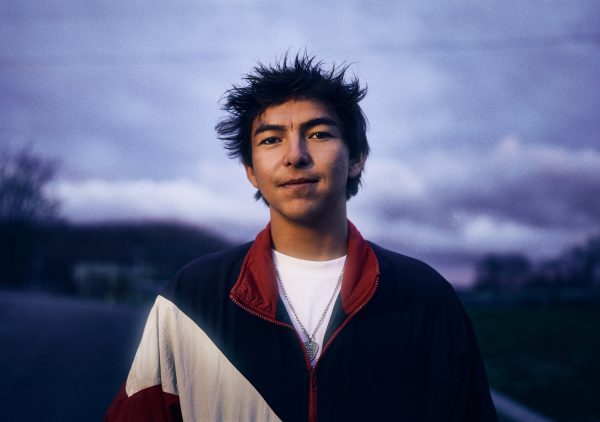
Wyatt Flores: Between the Road and the Ranch (photo by Matt Paskert)
There are worse places to figure out what comes next than a mountain, a hammock and a sky full of stars.
Wyatt Flores had been living in that temporary kingdom when we talked. He had been on the road, as usual, but this time he had managed to disappear for a few days. There was fishing ahead. Maybe horses. Cooler weather. A little distance from the machinery of touring.
It sounded, in other words, like Oklahoma without the Oklahoma.
“I’m from Stillwater, Oklahoma,” Flores says.
He is 25 now, an age that can feel young until you look backward and realize how much life has already happened.
“Now that I am 25 and looking back on a younger me, I’m like, oh, there’s a whole lot that’s happened. But man, I hate how fast it’s gone.”
For Flores, the distance between then and now is measured in more than years. It is measured in cattle and guitars, dirt bikes and barrooms, farm work and tour buses, one semester of college and more than a billion streams.
His sophomore album, Scared of Heights, arrives as the latest evidence of a musician still refusing to sit still. Produced by Charlie Handsome, Jacob “JKash” Hindlin and Gian Stone, the album stretches beyond the country and Red Dirt foundations of his 2024 debut, Welcome to the Plains, reaching toward early-2000s pop and rock without abandoning Flores’ gift for plainspoken storytelling.
The record is less a statement of arrival than a document of motion. That may be the more revealing way to understand Flores.

Stillwater is part of the explanation. The Oklahoma college town has been one of the great incubators of Red Dirt, a musical culture built from country, rock, folk and blues and transmitted through generations of musicians who never seemed particularly interested in respecting the boundaries between them. Flores grew up inside that world. His father, Noe, played drums. His uncle Bobby played guitar. Members of The Great Divide became early musical mentors. Flores remembers band practices, campfires, tailgates and the loose education that happens when a kid grows up around musicians rather than merely listening to records.
But music was only half the education.
Flores grew up on a ranch. He showed goats through 4-H, moved into cattle and FFA, learned the trade and eventually started raising cattle and show goats with friends through Top Shelf Genetics. Fence building remains, in his words, something he still hates.
The cattle, however, are different.
There is pleasure in working them, moving them, tending to something that has no interest in streaming numbers or record reviews.
That distinction has become increasingly important to him.
For a while, Flores says, he didn’t know how to come home. Music had become his job, his identity and his measure of himself. When the road stopped moving, he wasn’t sure what remained.
So he began returning to the person he had been before the career took off.
The ranch helped. So did the realization that a future built entirely around music might not be the future he wanted to leave behind.
His parents had taught him that a parent’s responsibility was to give children a better life than the one they inherited. Flores thinks about that when he talks about cattle and agriculture. Someday, he wants children of his own to have that part of his upbringing—the land, the work, the knowledge that something tangible can be built and handed down.
The irony is that Flores’ musical inheritance is just as tangible.
His mother loved ’90s country and, he jokes, seemed to own every George Strait CD ever made. His father brought classic rock and blues into the house. His sister exposed him to rap and the newer Red Dirt generation. Later came folk music and the lyricism he discovered at a festival in eastern Kentucky.
The categories kept multiplying. Flores followed.
“I just get bored,” he says. “I just keep wanting to find new things.”
That restlessness is one reason Scared of Heights doesn’t sound like a young artist carefully protecting the formula that made him successful. It sounds like someone testing the walls.
He has earned the right to do that. Flores has accumulated more than 1.4 billion streams, made his Grand Ole Opry debut, appeared on NPR’s Tiny Desk, The Late Show with Stephen Colbert and CBS Saturday Morning, and moved from Oklahoma barrooms to stages alongside artists he once regarded as heroes.
And yet some of the most revealing songs on Scared of Heights come from the old territory: doubt, loneliness, regret.
“Hate Myself” is a good example. Its narrator wants someone else to blame for the wreckage but can’t quite manufacture the anger. He was the one who left. The old relationship keeps appearing in his imagination, even in a passing glimpse of a familiar car.
The song’s wound is self-inflicted.
It isn’t heartbreak as melodrama. It is heartbreak after the excuses have run out.
That kind of inward gaze has been part of Flores’ writing from the beginning. He wrote “Travelin’ Kid” in a barn in roughly half an hour after someone at his first paid gig suggested he start writing his own songs. “Please Don’t Go,” one of his best-known songs, was only his tenth.
At the time, he was still farming and ranching, playing wherever somebody would let him plug in.
Eventually somebody paid him. His father told him that meant he was a professional. Flores wasn’t convinced. He is more convinced now, although the definition has changed.
The old version of professionalism involved getting paid. The newer version involves knowing what belongs to him and what doesn’t.
“I did my job,” he says of Scared of Heights. “I lived, I wrote, I recorded, I put it out.”
The numbers belong to the listeners. The response belongs to the audience. The songs belong to him.
It is an unusually sane philosophy for someone whose career has moved this quickly. At 25, Flores has already watched the music business give him more than he expected and take more out of him than he anticipated. He now talks about learning to accept uncertainty rather than trying to control every result.
There is another kind of uncertainty waiting behind him. The competition, as Garth Brooks once put it, is getting younger.
Flores sees it. He watches artists such as Waylon Wyatt and Baker Blankenship coming along and recognizes something familiar in them. He has already crossed the strange threshold where a young musician can open for a hero and then turn around and watch another young musician begin the same climb.
That is the peculiar privilege of getting older in music: eventually, the faces in the crowd begin to look like versions of yourself.
Flores isn’t finished becoming whatever comes next. At 25, he doesn’t need to be. He has the ranch waiting when the road gives him back, the music waiting when the ranch grows quiet, and a new batch of songs beginning to take shape.
Maybe that’s what the title Scared of Heights finally means. Not fear of getting high, but the vertigo that comes with realizing how far you’ve already climbed—and knowing there is still no map for the way down.
Flores is learning to live with that uncertainty. For now, that may be enough. The road is still there.
So is Oklahoma.
And somewhere between the two, Wyatt Flores is writing the next song.
Find more details here on his website: https://www.wyattfloresmusic.com
Enjoy some of our previous coverage here: REVIEW: Wyatt Flores “Scared of Heights”
For story ideas and suggestions, Brian D’Ambrosio may be reached at dambrosiobrian@hotmail.com