


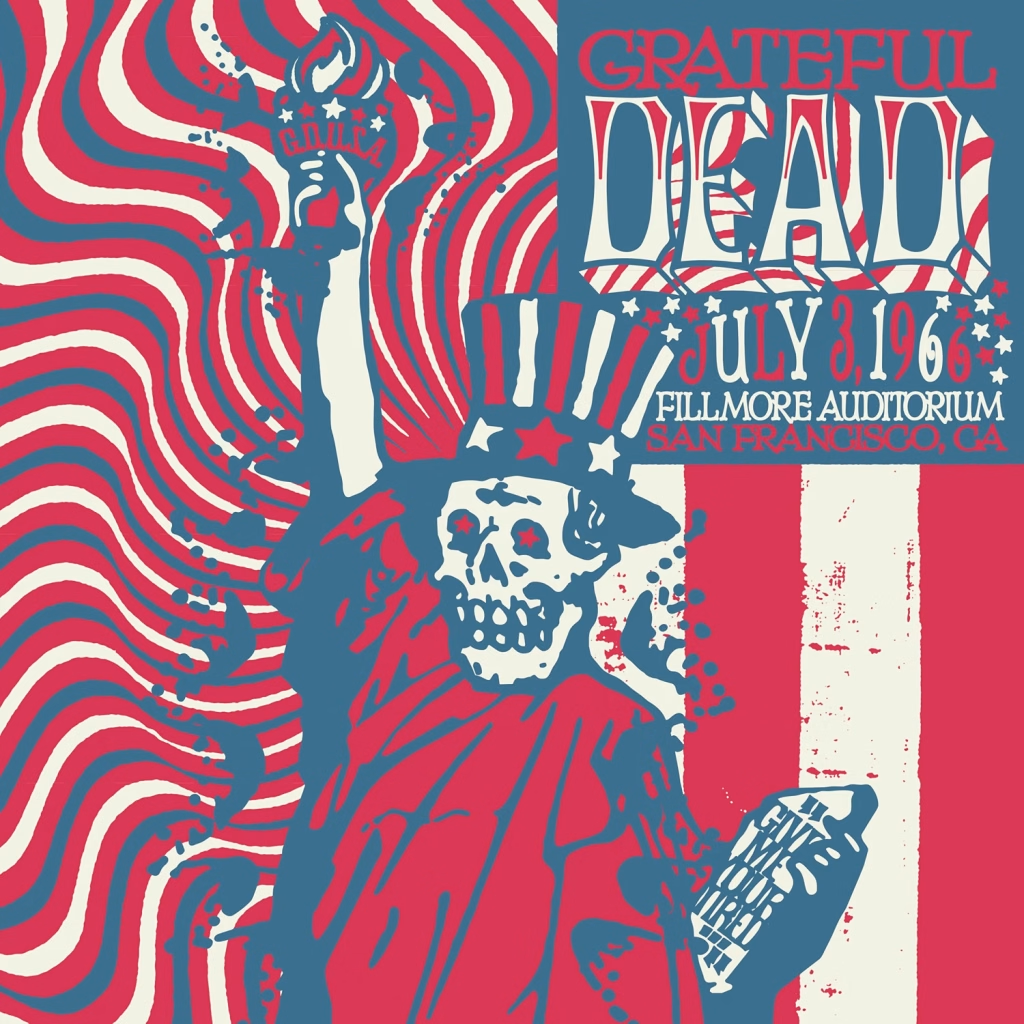
Want to hear how the Grateful Dead sounded in concert before its members conquered the world? If so, your best bet is July 3, 1966, Fillmore Auditorium, San Francisco, CA, which was released on the 60th anniversary of the event. The album preserves a show from only about a year after the group (then called the Warlocks) played its first gig at a pizza parlor. The Dead had yet to secure a record contract and was still six months away from making its first album.
Until now, the only way to hear this entire concert was to decimate your bank account and use the proceeds to purchase 30 Trips Around the Sun, an 80-CD box set from 2015 that includes it. Two of the show’s tracks also appear on a 2005 album called Rare Cuts and Oddities.
Little other Grateful Dead concert material from this period has survived. So Many Roads, a 1999 box, includes three live tracks from 1966, and Vintage Dead and Historic Dead, a pair of unofficially released albums from 1970 and 1971, respectively, purportedly contain September 1966 performances. Some live tracks from mid-July 1966 also show up in 1999’s So Many Roads and 2003’s Birth of the Dead. But the July 3, 1966, show is apparently the earliest full concert to be preserved.
For its existence, you can thank the Dead’s sound engineer (and acid supplier), Owsley “Bear” Stanley, who recorded the set. The audio has been remastered and restored with speed correction, resulting in consistently excellent sound quality. The only notable flaw is Stanley’s failure to hit the record button until partway through the show’s first number.

The set includes six of the nine songs that would surface on the group’s eponymous 1967 debut LP, among them “Sitting on Top of the World,” “Beat It on Down the Line,” “Cold Rain and Snow,” “New, New Minglewood Blues,” “Cream Puff War,” and “Viola Lee Blues.” Also in the program are a few obscurities, such as an organ-dominated cover of Johnny “Guitar” Watson’s “Gangster of Love,” Fontella Bass’s “Don’t Mess Up a Good Thing,” and two songs by Dead members: Ron “Pigpen” McKernan’s bluesy “Tastebud” and Phil Lesh’s “The Monster (Cardboard Cowboy).”
While consistently enjoyable, the two-CD (or three-LP) album differs in several ways from the Dead’s later work. For one thing, vocalist, keyboardist, and harpist McKernan features more prominently on many tracks than Jerry Garcia. Also, just five of the 19 selections are originals, and most of the numbers are relatively brief, with all but four lasting less than six minutes. Just one song—a set-closing, nearly 16-minute cover of Wilson Pickett’s “In the Midnight Hour”—evokes the extended jams that became a regular feature at later Dead concerts.
What’s more remarkable than the differences between this concert and the Dead’s later work are the similarities, however. Granted, the group sometimes sounds more like a blues- and folk-influenced dance band than the improvisational-focused, psychedelia-infused outfit it became. But the program features several songs that the Dead continued to perform in later years, including some of the ones from the debut album as well as covers of “Big Boss Man,” which is most associated with Jimmy Reed, the traditional “I Know You Rider,” and “Dancing in the Street,” the 1964 hit by Martha Reeves and the Vandellas. Throughout, moreover, there are more than a few musical hints of where the Dead was headed. It’s unlikely that anyone who attended this exhilarating concert in 1966 would be surprised to learn what followed in subsequent decades.


A Sterling Live Set from Elliott Murphy
Rock singer/songwriter, guitarist, and harmonica player Elliott Murphy has released more than 50 albums during his long career, and virtually all of them are worth owning. But you have to start somewhere and, if you’re new to his music, you’ll find that Le Havre Live, Murphy’s latest concert album, offers an excellent way to get introduced.
Featuring an April 2026 show in France, where this native New Yorker has lived since 1989, the record does a great job of showcasing his commanding vocals and literate verse about a wide range of subjects. Supporting Murphy, who plays rhythm guitar and harmonica, are three longtime accompanists—ace lead guitarist Olivier Durand, violinist Melissa Cox, and percussionist Alan Fatras, all of whom add backing vocals. Also on hand is bassist Aurelien Barbolosi, a relative newcomer to the group.
The hour-long, 12-track soundboard recording (with no overdubs) taps standouts from throughout Murphy’s career. “Last of the Rock Stars,” which also served as the lead-off track on his 1974 debut album, Aquashow, opens the concert, which features several other oldies. Those include the title cut from 1977’s Just a Story from America, and “Visions of the Night,” “Deco Dance,” and “You Never Know What You’re in For” from 1975’s Lost Generation and Night Lights. Also on the program are numbers such as “On Elvis Presley’s Birthday,” from 1993’s Unreal City, “Green River,” from 2003’s Strings of the Storm, “Not Enough Time,” from 2005’s Coming Home Again, and “The Miracle Zone,” which first showed up on a 2025 EP called The Tree of Life.

Murphy has previously released other live versions of most of these songs, but like Bob Dylan and Bruce Springsteen, he has a penchant for reinventing his own work. (In 2015, for example, he released an album called Aquashow Deconstructed that includes reimagined versions of every tune on his debut LP.) “Just a Story from America,” a bouncy, pop-flavored rocker in its original version, shows up here as a leisurely delivered, nearly a cappella folk ballad. “Last of the Rock Stars,” which also rocked hard in its first rendition, is similarly slowed down and moody.
Murphy hits the gas pedal several times on this album, however. “Green River,” one of his best rockers, garners a nearly six-minute, high-octane reading, for instance, and befitting its title, the fiddle-spiced “Deco Dance” is danceable.

____________________
Jeff Burger’s website, byjeffburger.com, contains more than four decades’ worth of music reviews and commentary. His books include Dylan on Dylan: Interviews and Encounters, Lennon on Lennon: Conversations with John Lennon, Leonard Cohen on Leonard Cohen: Interviews and Encounters, and Springsteen on Springsteen: Interviews, Speeches, and Encounters.