


The Arcadian Wild photos by Shelby Mick
Isaac Horn of The Arcadian Wild on The Risks and Rewards Behind Make It Out Alive
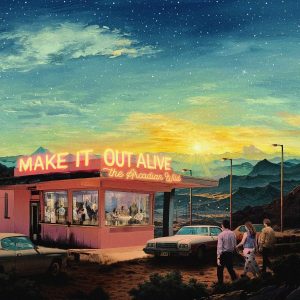
Nashville-based Indie Folk trio The Arcadian Wild just released their new album, Make It Out Alive, on August 15th, 2026, and are following it with US tour dates this Fall. Building on ten years together as a band, they jumped into some new experiences this time around by focusing on co-writing the new tracks and also by working with an outside producer, Micah Tawlks. It was a rewarding experience for them to shake things up in this way, and led them into some of their most daring compositions and performances, from the broad view of life’s changes in “Spinnin’,” to the all-embracing hopefulness of “Jubilee.”

Isaac Horn (guitar), Lincoln Mick (mandolin), and Bailey Warren (violin) even took on the challenge of doing some of their orchestration in the studio for the first time, leaving room for new ideas and developments, in contrast to their previous albums. The energy we encounter on Make It Out Alive speaks to the live play dedication, while the bigger sound they managed to build this time around only adds color to their vision for the album. I spoke with Isaac Horn about the writing and recording process, trying new things, being in a band together for over ten years, and about the ideas behind some of the expansive tracks on Make It Out Alive.
Americana Highways: If you had to pick a point in time where this album really started for you, what would you say?
Isaac Horn: It’s 2026 now, we record it last year. Some of these songs we started writing a couple years ago, but we did a lot of co-writing this time, which we have not ever done before. Typically, someone in the band will have the song, and have the majority of it fleshed out. Then, we’ll do the arranging together. But this time, for whatever reason, we decided to try coming to the table with no ideas, just seeing what we could put together. “Impressions” was the first one that we did that with, and that was two or three years ago. At that point, we were just writing, without an album in mind.
It didn’t really get real for me until we were in the studio and tracking the songs. I just really love that part of the process. I feel like it’s then that these songs that you’ve been sitting with awhile, kind of get new life. And that’s in the same way that they do when you start performing them, and they start to feel new again. We had all these songs, and chose which ones we were going to do, then in the studio, we started to stumble into new ideas, saying, “What if we put that instrument on it?” That’s when we started really moving from writing a bunch of songs into making an album.
AH: It sounds like a lot of development for you still happened in the studio, the finalizing of ideas. You were still willing to introduce new developments.
IH: That was the case this time around, but we had never done that before. That time in the studio for this album feels like such a pillar of the experience, maybe for that reason. In the past, we’ve just said, “How, in the studio, can we replicate how we sound live?” Really, it was just putting a mic in front of us, and playing songs. There wasn’t a whole lot of exploring in the studio. This time around, on purpose, we said, “Let’s not fully arrange everything before we get there. Let’s start brainstorming about our friends, what they play, and whether we can invite them into the process.” So this time around, there was a ton of putting the finishing touches on it. In some case, in the studio, we totally flipped a song upside down and made it something that it wasn’t before.
AH: Can you remember and share about a specific song that changed a lot in the studio?
IH: Yes, “Spinnin’” was one like that. We had arranged it, but we went in with all of the songs where we were trying to leave space for them to shift. Some of the songs were good to go, but our Producer, Micah, said, “What if we just picked one song where on purpose everyone played an instrument that they do not play, typically?”
AH: Whoa, that sounds scary.
IH: Right? We said, “What an insane idea! Okay, let’s try it.” Bailey, who typically plays banjo, played mandolin on that one, Lincoln, who typically plays mandolin, played tenor guitar, and I got off the easiest, because I play guitar, but all I did was play a nylon string guitar, a classical guitar. I didn’t have to re-learn anything. Then, we had a full drum kit, which is also something that we haven’t really done much before. So “Spinnin’” was the song that was chosen to do that. “Scary” may be overdramatic, but it was one of those moments where you say, “I don’t know if this is going to work.”
AH: It was uncomfortable.
IH: It was totally uncomfortable. [Laughs] But, uncomfortable in the way that it is whenever you’re just learning something new, like learning to play a new game, and you’re uncomfortable because you’ve never done it before. But it’s still exciting. It felt like we were in a sandbox.
AH: A lot of people recommend that mindset for creative work, because if you put too much pressure on creative work, it can kind of choke the life out of it.
IH: Yep! I have choked many a song to death, for sure! [Laughs]
AH: I’m interested to hear that “Spinnin’” is the song that was part of that experiment, because in my view, it is so very impressive. That song is really something. I think it’s a great example of what you all can do, kind of like your version of The Byrds’ song “Turn! Turn! Turn!” It has that kind of big feeling to it.
IH: Cool! No one has ever made that connection, thank you.
AH: You’re welcome. It has so many great observations linking seasons to human emotional worlds, linking the inside and the outside world. I had wondered how you recorded that song, because there are a lot of things going on, and it would have been a stretch to record live and get all the details. But the bigger sound is so necessary here and feels almost orchestral.
IH: We didn’t do it with all of us live, but because we’re most comfortable playing live, we tried it that way. At first, it was, “Alright, Isaac, get in there, play the guitar part.” It felt so dull to layer it, one layer at a time. It wasn’t working. So what we did was, even though it took longer, is that we did the first few takes with everybody. We got a decent performance of the full band playing, but we were focusing on capturing one instrument. Once we got a decent performance, everyone else left, and I kept on playing my guitar part, but I was playing along to the live band that we’d just tracked. Then, we did the same thing for each instrument. So, it wasn’t live, it wasn’t all at once, but we were playing along with a live version of the track, if that makes sense.
AH: Yes, it’s like an establishing take, an establishing shot in filmmaking. I don’t think I’ve ever heard an artist or a band describe their process in exactly that way. It’s like you’ve cut out the pattern as the foundation of the track.
IH: I’m going to use “establishing take.” I like that!
AH: “Spinnin’” is an excellent song, but there are a lot of great songs on the album. One that is a bit more mysterious is “Comes Around Again,” which was a single release with a video, like “Spinnin’.” I don’t want to decide to firmly what that song is about, but I think there is some talk of establishing boundaries, and taking a certain stance about where you are as a person or group, versus how other people might behave. There are little ideas of conflict, but it’s not a super-heavy song.
IH: That’s one that we were a little sheepish about, because as you’ve said, it’s not this crazy-aggressive song, but compared to the songs that we’ve written up to this point, it stands out. We don’t tend to be very critical people. If we’re critical, we’re critical of ourselves, not someone else. But, you’re right. That is a super-real song. We know all of the gritty details behind it, but it’s nice to hear that you can pick up on a degree of positivity in it. That’s important to us. We were really just trying to be honest, and if you’re truly honest, and it’s not about having it out for someone, even when you’re being critical, there can be a degree of positivity. That’s there because it’s nice to stand up for yourself, sometimes. And it’s so easy to just not do that.
AH: Right. There’s no one who is going to get through life without feeling pushed around at some point. I think a lot of “nice” people spend time beating themselves up about it, but it is good to say, “I know how I feel about it, and I know what my strategies are for dealing with it.”
IH: Yes. And I think something that’s scared me away from taking stances like that is the realization that I might feel differently later. I know I’m going to change. I hesitate to put my foot down sometimes, but that, ultimately, is not helpful. That’s not a good reason to not take some stance, now.
AH: I guess so, because now might be the only opportunity that you have. But I know what you mean about thinking you’ll feel different later.
IH: Right! You’re basing that on an eventuality that’s not guaranteed at all. But you’re working towards let it go. But maybe saying how you feel, loudly, in this moment, might be part of it! [Laughs]
AH: One obvious point I’ll mention is that when you all take on themes you don’t normally explore, it probably opens up opportunities for sounds that you don’t always use. I think the sound of this song is interesting for that reason, too. It’s a little more quiet, conversational, and tough. The video really reinforces that you, as a group, are a unified front, too.
IH: We are, because we’ve just been doing this so long at this point. And if something happens to one of us, it really happens to all of us. If something positive happens to somebody, all of us reap the benefits, but the same goes for something negative, or challenging.
AH: That’s very empathetic, but also tricky, I’m sure.
IH: It’s somewhere between best friend, sibling, and spouse, being in a band together. I think if everyone knew, I don’t know if anyone would be in a band. But that’s true of so many things where knowing the details might scare you away.
AH: You’re almost reminding me of a quote from another song on this album, “See It To Believe It,” that if I had to go this alone, I wouldn’t go back, I wouldn’t do it.
IH: Right!
AH: The flipside is how lonely it can be to be a solo artist. It’s the freedom versus the loneliness.
IH: That’s true. I think even the positive things, the victories, are a lot duller if you’re by yourself. Going out on your own has new frustrations, but all of the victories would fall flat. There’s something so special about getting in the van after something great happens, and high-fiving all around, and saying, “That was so amazing!” Then, there’s something really cathartic about being able to mutually complain, even if it’s about something small and dumb, that just happened to all of us. Then, suddenly, it’s no problem. And “See It To Believe It” is just totally that.
AH: I want to throw in a comment about “Jubilee.” That’s flown under the radar, as if it’s an understated track, when it’s not. I feel like that might be the secret key to the album.
IH: I hope so. There is something special about how an album opens. You don’t necessarily need a single to put a spotlight on it. A song that starts an album has an opportunity to speak for itself, and set the tone for things. We really get into some challenging topics on the album, like fractured relationships, but also relationships that have been put back together, grief, loss, and friendship, loss of friendship. All that kind of stuff. Since that’s the whole album, we wanted to start the album with “Jubilee,” to set the tone, through which we can see all these other things. Maybe there’s a degree of hope that can bring purpose to all of the really dark things that just kind of happen to us. I’m glad you like that one. I hope other people like it, too.
AH: It sounds amazing, and it has some great lyrics. It made me think of the idea that when you’re really happy in life, no one can really take that away from you. Even if bad things come at you, out of the blue, which might shake you up, if you’re really happy, that’s something that belongs to you regardless. I think it’s a hopeful picture of a mental and emotional place that people can reach.
IH: Yes, I think there is definitely something in us, somewhere, that is untouchable, whether we’re caring for that part of ourselves or not. No one touches that part of us. I think if you can foster a degree of life there, for yourself, and joy, and hopefulness, that it does kind of radiate out into other aspects of your life. It’s certainly not saying, “Then everything is good, and you have nothing else to worry about.” Because, then, the rest of the album happens. Then there are still all of these things that happen to us in life. But I hope that the rays of “Jubilee” will still be touching the darkest parts of the album and kind of radiate throughout the album. That’s my hope.
Thanks very much for chatting with us Isaac Horn!
More details are available here on the Arcadian Wild website: https://www.thearcadianwild.com/