


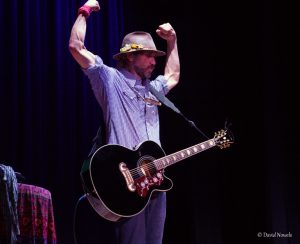
Todd Snider photos by David Nowels


Last week’s news that Todd Snider had died hit me hard. Much harder than I would have guessed. From what I’ve read online—and I’ve read a lot online—that seems to be true for many people. Snider was a real one of one, a singular talent whose songwriting, stories, and generosity toward other artists made him one of the most important Americana voices of his generation.
And yet, he was far from widely known. I’ve never met many listeners who were lukewarm about him. People tend to fall into two camps: “God, I love that guy,” or “Who is Todd Snider?”
A Musical Shibboleth
Over the years, I came to think of Snider as my own musical shibboleth. A shibboleth is a word, custom, or behavior that distinguishes one group of people from another. As I learned in religious school—or maybe from that outstanding episode of The West Wing—the term comes from a biblical story in which one tribe used the pronunciation of the word “shibboleth” to identify and kill fleeing members of another tribe who couldn’t pronounce the “sh” sound.
Asking about Todd Snider was my version of that test. If someone knew his music, they were almost always a fellow traveler. They wouldn’t respond with a Bible story; they’d quote Snider: “Ain’t no shame in being crazy,” or “I can’t complain, but sometimes I still do.” They’d talk about East Nashville Skyline or Agnostic Hymns & Stoner Fables, “Beer Run” or “Play a Train Song.”
If they didn’t know him, I’d direct them to a handful of great songs and tell them to start there—my small act of musical evangelism.
The Chain of Storytellers
Snider’s work didn’t appear out of nowhere. He stood squarely in a lineage of songwriters who mixed truth, humor, and heartbreak in equal measure—a chain that runs from Guy Clark’s plainspoken poetry to John Prine’s sly compassion, through Jerry Jeff Walker’s rambling spirit and Kris Kristofferson’s literary grit. Snider absorbed all of that and turned it into something unmistakably his own: funny, political, deeply human, and always conversational.
And he passed that spark forward. You can hear his fingerprints on the wry intelligence of Aaron Lee Tasjan, the restless wit of Hayes Carll, the fierce empathy of S.G. Goodman, and the crooked, big-hearted sincerity of Willi Carlisle. Snider bridged the gap between the old guard and the next wave—keeping the songs honest, the jokes sharp, and the heart wide open.
The Other Nashville
Snider also helped give shape and soul to another Nashville—the one across the river. Long before “East Nashville” became shorthand for a scene, Todd Snider was its unofficial mayor. While Music Row polished its product for radio, Snider and his friends were building something looser, humbler, and more honest. His house became a hangout, his porch an open mic, his friendship a kind of passport into a community that valued stories over singles.
That East Nashville ethos—do-it-yourself, openhearted, proudly unpolished—owes more than a little to Snider. He showed that you could live in Nashville without being Nashville. You could make music rooted in truth, not trends; built on community, not commerce. And in the process, he made room for hundreds of songwriters who didn’t quite fit the mold but still belonged.
Songs from Quarantine
That sense of community was especially visible—and especially important—during the pandemic. When the world shut down, Snider opened up. Week after week, he streamed casual, unguarded shows—part concert, part sermon, part therapy session—under banners like What It Is and The First Agnostic Church of Hope and Wonder. Alone with a guitar, a dog, and a mischievous grin, he created a kind of digital front porch where scattered fans could gather.
He played the hits, tried out new songs, told long, looping stories that went nowhere in particular but somehow landed right where you needed them to. At a time when music felt distant and abstract, Snider made it personal again. Those livestreams reminded us that connection doesn’t require proximity—just presence, humor, and heart.
Sunshine in the Shadows
My wife often questions my musical preferences. She’s not wrong that I tend to favor the melancholy (John Moreland, Richard Thompson, Lucinda Williams). “Don’t you like anyone who’s happy?” she asks. And though few singer-songwriters are what you’d call well-adjusted, I always thought of Todd Snider as an exception.
Not because his life was easy—he was open about addiction and struggle—but because he never lost his sense of joy. His humor wasn’t a mask; it was a worldview. He found sunshine where others might just see clouds.
Snider wrote — he would say “made up” — songs about small-town lifers, lovable screw-ups, and big-hearted drifters. He told their stories with empathy and wit, without judgment. He understood that decency mattered more than success, that kindness mattered more than cleverness.
And he could flat-out write. Few lines in modern Americana capture the human condition more efficiently than “We’re all waiting to see if life’s as hard as it seems,” or “Happiness ain’t prison, but there’s freedom in a broken heart.” He could also nail a whole philosophy in a single shrug: “It don’t have to be true, it just has to sound good,” he sang—both self-deprecating and deeply honest about the storyteller’s art. In another, he offered the simplest kind of faith: “Enjoy yourself, it’s later than you think.”

A Songwriter Who Felt Like a Friend
Snider’s albums always felt like conversations you wanted to keep going—equal parts confession and comedy routine. The stories between songs, the way he talked about songs, became part of his legend. Even through recordings and interviews, you could feel the intimacy, the camaraderie.
Maybe that’s why his death feels so personal. Because Snider didn’t sing at us—he sang with us. He made room for all of our contradictions: joy and regret, humor and heartbreak, rebellion and faith.
He once said that all he ever wanted was to “make up songs until I die.” He did that. And in doing so, he gave the rest of us a little more music to live by, a little more light to see with, a little more reason to believe in this odd, beautiful, ramshackle community we call Americana.
Play a Train Song, brother. Play a Train Song.
Enjoy some of our previous coverage here: Interview: Todd Snider on Cash Cabin Sessions, Dreams and Songwriting here: REVIEW: The Road Goes On: Todd Snider’s “High Lonesome Journey” and here: Show Reviews: Todd Snider Improvised with Abandon with Tim Easton at the Auditorium at the Douglass
Check his website here: https://toddsnider.net