


Ryan Lee Crosby on Collaborating With Jimmy “Duck” Holmes For Live Album At The Blue Front
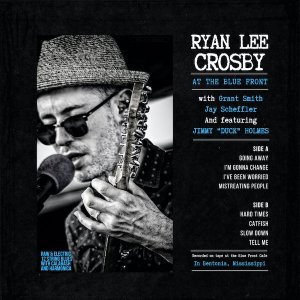

Ryan Lee Crosby is a guitarist, vocalist, songwriter, and educator in the Blues tradition, and more specifically in the Bentonia Blues tradition of Bentonia, Mississippi. His mentor for a number of years now has been Jimmy “Duck” Holmes, who is the owner of the culturally important Blue Front café and the descendant of its original owners. Two records have been released this year that document the time that Crosby has spent in recent years at the Blue Front and learning from Jimmy “Duck” Holmes. Holmes’ own album, Bentonia Blues / Right Now, arrived this summer in June, and now, Crosby’s new album, which features Holmes prominently collaborating along with Grant Smith and Jay Scheffler, At The Blue Front, has also been released by Crossnote Records.
Captured live with analog equipment at the Blue Front, the recordings were made without a specific intention of release, but allowing things to unfold spontaneously. Crosby then produced and mixed the recordings himself, a new venture for him. Not only do the albums capture a specific moment in time and the flowering of an important blues tradition, but they offer a window on collaboration between players, and the ways in which mentorship ensures rich continuity in blues music. Now that the albums are out, Crosby will also be taking the music on the road in Massachusetts, New York, New Jersey, and Vermont. I spoke with Ryan Lee Crosby about taking a leap into recording, taking his students down to Mississippi to learn from Holmes, and the subtle but important impact that learning in person can have.
Americana Highways: I knew that you had released an album that you recorded for Jimmy “Duck” Holmes, and now I realize that you actually recorded his album, and your own live album, At The Blue Front, at the same time, on the same visit down to Mississippi. That makes a lot of practical sense.
Ryan Lee Crosby: The whole process, which I feel really good about, is that these were the first records I’ve put out where there was no kind of preconceived idea about making a record. With all the other albums I’ve put out, there’s been the idea of, “I wrote these songs…I developed this repertoire…I’m recording these songs with this person and we’re going to put this out.” So it would be decided that I was going to put it out before the record was even made. What I’ve come to recognize is that that is almost placing a demand upon the music before it’s even made.
But with At The Blue Front, and with Jimmy’s record, they were both recorded in the same sessions, on a Monday and a Tuesday afternoon, and I just had this strong desire to bring a tape machine down to the Blue Front for a couple days to see what would happen. So I just took all my stuff down there, recorded for two days, and there was no discussion, no planning, and no talking about the songs. The way that Jimmy works, I think, is that it’s all pretty non-verbal, and you just communicate through the language of music. The sessions themselves were very focused and there was a very heightened atmosphere, I think, but there was no kind of plan for a commercial release. It was purely driven by a desire to play together. And, essentially, as I see, to just document a relationship, or a mentorship.
Over the last five years, since we last spoke, I’ve been going to Bentonia to study with Jimmy, and learn about the Bentonia style as closely as I can. I’ve really spent a lot of time trying to transcribe the music, and learn it as best I can, so these two sessions, and these two albums that have come out this year, are really just a reflection of that.
AH: When you say “transcribe,” do you mean writing down sheet music, or do you mean making recordings?
RLC: Both, really, but I was referring to the writing down of tablature, really. Maybe one day I’ll ask some guitar player friends of mine who are sight-readers to put it into sheet music. Jimmy is always quick to say that you can’t really write the music down. But I’ve been transcribing it, and teaching it since the lockdown. Something that I’ve been doing for the last couple of years, that’s really sweet and meaningful to me, is that I’ve been taking my students, who are learning the Bentonia style from me, to the Blue Front to meet Jimmy and learn from him. That’s kind of how the record came about, in a way, because we knew that we were going to down to play a festival, and to bring some of my students there, so I just brought my tape recorder, too. We just ended up doing all of this stuff in just about one week.
AH: I’m so amazed that you are now bringing your students down, too. That’s great. What sort of age are your students?
RLC: In the first year, there were 8 or 9 that came down. In the second year, there were 5 or 6. Up until this point, we just did this casually to see if it would be a nice thing. But it’s been really positive, and it seemed like Jimmy really enjoyed it. He’s been so generous about it. I’ve seen the way he interacts with people just walking in the Blue Front, and he really wants to share with them. As for ages, right now the age range goes from anywhere from in their late twenties to being in their late 60s to early 70s.
AH: That is an amazing age-range. I love to see how the blues is a part of their lives across the board.
RLC: I know that when I’m seeing or playing shows, I love seeing people of different ages, and I hope that continues.
AH: Do you think that it impacts the students’ growth as players, as interpreters of blues, to have been there in person? Can you see a difference?
RLC: I think so, yes. What I notice for sure, and I’ve experienced for myself, too, is that going there for me has really changed how I relate to the music. I feel like I see that in some of my students, too, who I meet with regularly. I see a lot of people on Zoom, and the people who study with me live all over the country, so I don’t get to hear them play in a room all the time. A lot of this is from a group class that I teach, and usually they are listening to me play, so I don’t get to hear them all play in real-time. Some of them I see in person.
But I think the emotion, and spiritual impact of going there seems to be something that really affects people in a way that I find hard to articulate. I don’t know if I can explain it, but I think that Jimmy is such a singular musician, even within the Bentonia tradition, that it’s almost impossible not to be moved by that. But there’s also the feeling of the Blue Front, which aside from the plumbing they put in a few years ago, is essentially unchanged from when they opened, more or less.
You kind of feel a connection to the past in there. And something about Jimmy’s playing connects me, and seems to connect other people as well, with the whole history of the Blues and with the Bentonia style in his playing. But he also sounds really unique within that tradition, and something that really speaks to the present moment is the importance of being oneself.
With the world that we live in, with algorithms, and everything, there’s a lot out there that discourages us from being ourselves. So being around someone who is so thoroughly themselves is inspiring.
AH: When I listen to this album, I also feel like I hear a huge leap forward for you in your performance, both on the guitar, and vocally. I was really struck by the energy and what you were allowing yourself to do. It seemed much more off the leash. It’s a really vibrant album, and I think some of that is because you’ve spent so much time there, and in between, working so hard to be fluent. It has probably also been that teaching has affected you, and the way that you communicate musically, now.
RLC: Thank you. I can’t really say how good that makes me feel. The last record was made with Bruce Watson in his studio, and I think so highly of all the records he has produced. It’s so much of what has inspired me to study the blues. But I’ve essentially produced this one myself, and it does feel like a step forward to me, but it’s good to hear that from someone else, and that it comes through.
AH: I read a description of the equipment that you used for this, listed in an interview in Premier Guitar Magazine, and it actually seemed like a lot! Clearly it needed a lot of planning just to record, even if you didn’t have intentions of making an album. You made this the best field recording that it could be.
RLC: I produced, recorded, and mixed both records, and it was an interesting sensation those two days, because in some ways, I was feeling nervous, but there was also a kind of strange calm over it all, too. There was a lot of care in the room between all of us. One one level, it was very calm in the sessions, but on another level, between the sessions, I was aware of all the moving parts. It was a station wagon jammed full of equipment.
When you do it all analog, every little thing that you need is a piece of the puzzle, and it fills up a car. It was a lot to manage, but I did feel very intentional about wanting to do it that way. A lot of the recordings that inspired me to do this in the first place were, arguably, very low-fidelity field-recordings. Where Alan Lomax or David Evans brought a tape recorder. There are some recordings that were made in the Blue Front of some of the older musicians, and I wanted to participate in that. I also love recording on tape so much, that I felt it was the only way to do it.
It’s a miracle that the tape recorder even made the 1500 mile journey down there, and still worked when it got there, and still worked when we brought it home.
AH: It’s all vintage equipment?
RLC: Oh yes, and the vintage recorder that I used, I bought last-minute from somebody in Connecticut, another producer who holds onto a lot of old gear. I think that he found this one, maybe on the side of the road. It wasn’t in pristine condition, but it was portable, so I took a leap! You’re not really supposed to move these machines around. All of it was a calculated risk, but I feel like there was a benevolent hand in it all.
There was a big eclipse last year in April, and the first session was on the day of the eclipse. That was the session where I think we got most of the material. There was the eclipse outside, and it was kind of dark. I feel like the mood of the sessions mirrored what it was like with the eclipse out there. It was a special couple of days.
That eclipse sure was memorable. Thanks very much for chatting with us, Ryan Lee Crosby. Find more information here on his website: https://ryanleecrosby.com/
Enjoy our previous interview here: Ryan Lee Crosby Brings The Heat and The Cold To “Winter Hill Blues”; Interview
Check out more music with Jimmy “Duck” Holmes here: REVIEW: Robert Connely Farr “Dirty South Blues” with Jimmy “Duck” Holmes