


Abe Partridge and Jack Barksdale Deliver Timeless Musical Truths at Ram’s Head in Annapolis
photos by Allison O’Brien/AOB Photos


From Woody Guthrie to John Prine, the Americana tradition has thrived on songs that make you think and songs that make you feel. The very best manage to do both. That’s why I chase nights like this one at Ram’s Head, when Abe Partridge and Jack Barksdale took the stage. Two very different songwriters—one a battle-scarred Gulf Coast poet and artist, the other a precociously wise Texan barely out of his teens—reminded me that powerful music isn’t bound to an era. It’s carried forward, song by song, by artists who see the world clearly and aren’t afraid to tell you what they find.
Abe Partridge: Where Faith, War, and Art Collide
Abe Partridge commands the stage with a weathered gaze that shifts between preacher’s conviction and painter’s wonder. His background is as winding as his lyrics suggest: raised in Mobile, he was a fundamentalist Baptist preacher before enlisting in the army and serving in Quatar. He came home to Alabama and eventually poured that lived turbulence into songwriting and painting. That collision of faith, violence, and art—gives his songs a gravity that recalls Kris Kristofferson’s plainspoken poetry, the late John Prine’s mix of tenderness and bite, and Hayes Carll’s ability to lace a joke with melancholy.
One of the night’s most affecting moments came when Partridge introduced “JJP from Elba, Ala.” He held up a battered WWII canteen engraved with his grandfather’s name—James Jewell Padgett—a farm boy from Coffee County, Alabama, who carried it through the Battle of the Bulge. The song tells his story with unflinching honesty, chronicling a young man who sailed to war, buried brothers in Europe, and returned with a soul “split in two.” As Partridge sang, “They took his plow and gave him a gun / Fighting the Nazis nail and tooth, till he came home with a broken soul,” the weight of inherited trauma filled the room.
The song has already reached beyond the stage—it is the centerpiece of a new documentary in which Partridge retraced his grandfather’s wartime steps through Belgium and Luxembourg, guitar in hand, playing at the very battlefields where JJP once stood with a rifle. “Where my grandfather had to go with a gun,” Partridge explains in the film, “I’m going to go with a guitar.” Seeing him perform it live—with the canteen resting on a stool beside him—was a reminder that great songs aren’t just written, they’re inherited.
Partridge’s wanderings make sense for someone who has struggled to find his place in the world. In “Black Flag T-Shirt Lament,” he recounts trying to fit in as a punk music-loving kid among country devotees. He sings “I’ll close my eyes and sing to God / ’cause I know you wouldn’t listen anyhow” with the resignation of a man who’s tried both prayer and rebellion and found them equally insufficient.
But if you’re getting the impression that Partridge was a grim reporter of facts, you need to hear “Alabama Astronauts,” about an alien invasion in an Alabama trailer park that sounds like what you might expect if Kate McKinnion’s Saturday Night Live character Colleen Rafferty sang about her alien abductions rather than just talking about them. It’s a totally unhinged four minutes that celebrates the absurd with lines like, “And I even stole a little space traveling cart, I got it out in the barn / And me and Bubba painted it camouflage and we’re about to embark / As an interstellar, white trash Lewis and Clark / We’re gonna be the first Alabama astronauts.” That same celebration of the ridiculous was at the heart of Partidge’s final song, the exquisitely titled “Talkin’ Never Stare into the Eyes of a Chicken Blues,” which is every bit as strange and wonderful as it sounds.
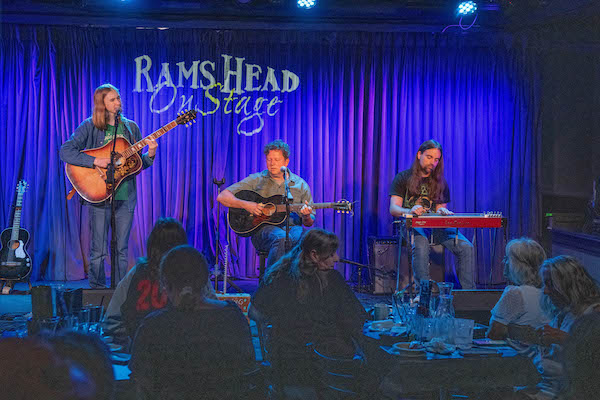
Throughout his set, Partridge was accompanied by Austin Harper on pedal steel guitar, or as Partridge called it, “the sad machine”—a perfect description for an instrument that can make even joy sound melancholic. https://www.abepartridge.com
Jack Barksdale: Youth with an Old Soul
If Partridge brought the grit and gravitas, Jack Barksdale balanced the bill with wide-eyed precision and a winning stage presence that immediately put the audience at ease. At an age when most players are still fumbling through their first open mics, this Fort Worth native has already developed a songwriter’s instinct for restraint and the confidence to connect with a room full of strangers. His lyrics carry echoes of fellow Texan Townes Van Zandt’s sparse imagery, but his delivery is all his own—earnest, unhurried, and disarmingly assured.
His opening song, “Only Human,” was a perfect introduction, sung quickly and showcasing an avalanche of words that would have been at home in a Josh Ritter song. It also featured Barksdale’s easy-to-underestimate guitar playing—never flashy, never boring, threading a difficult needle with apparent ease. His “Song for the Sad State of this Art Form” captured the challenge of, as he sang, “living high off low expectations.”
Songs like “Widow of the Wind” and “Before I’ve Gone” felt timeless, not because they were reaching for nostalgia, but because they trusted simplicity. Where Partridge’s set felt like weathered oak, Barksdale’s was fresh pine—different grains, same sturdy craft. https://jackbarksdale.com Enjoy our review here: REVIEW: Jack Barksdale “Voices”
A Conversation Across Generations
The two artists joined forces for a pair of songs that highlighted their complementary strengths: “I’m Done,” which they wrote together, and a wonderful cover of John Prine’s “Crazy as a Loon.” These collaborations revealed that the contrast between the two wasn’t a division but a conversation—between generations, geographies, and life experience.
By the end of the night, both had proved what Americana has always known: truth travels best when it’s set to a good melody and sung without pretense. In Partridge’s case, that truth comes battle-tested and spiritually scarred. In Barksdale’s, it arrives with the clarity that sometimes only youth can provide. Together, they reminded us why this music endures—not because it’s old, but because it stays honest.