


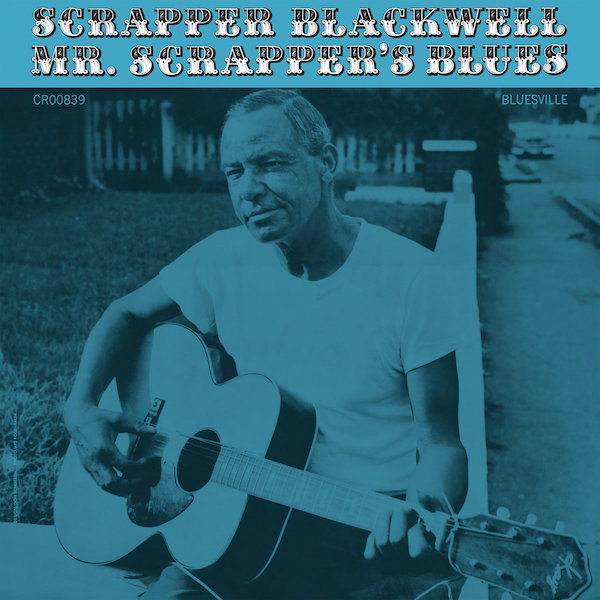
Scrapper Blackwell – Mr. Scrapper’s Blues
Recorded in 1962, this is Scrapper’s 2nd LP during his return to recording & was originally released on Bluesville Records. The LP is fairly trim instrumentally since it only features Scrapper (vocals/acoustic guitar/piano).
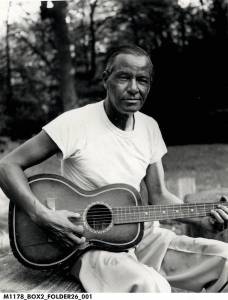

Born in South Carolina (1903) as Francis Hillman Blackwell, he lived most of his life in Indianapolis, Indiana. He became an American bluesman who was pre-Muddy Waters & pre-Chuck Berry. As a young boy, I started to listen to him because his blues was more personal, subtle & quite profoundly different from what I had already heard.
Mr. Blackwell’s first career (with pianist Leroy Carr) stretched between 1928-1936 & ended with the alcoholic death of Carr. Scrapper retired from music. He returned to music from 1958-1962. This 10-track final album, during his lifetime, Mr. Scrapper’s Blues (Dropped March 25/Craft Recordings/Concord) was produced by Arthur Rosenbaum.

What’s cool about Scrapper’s vocals is the tone, raw phrasing & intonation. Many people focus on artists like Charlie Patton & Robert Johnson, which is fine historically & if you’re a musician. However, Scrapper Blackwell was recorded with more clarity than they were even back in the late 20s & early 30s. His guitar explorations are unique as well. Many accomplished guitarists still try to figure out what Mr. Blackwell was doing on some of his tunes.
His performance isn’t highly polished like today’s blues artists (in an entertainment manner), but it’s authentic, rural & gutsy. While today’s blues artists get down in the dirt of the music, Scrapper got down & muddied it up to give it a thick consistency. This set captures his “electrifying” acoustic guitar work pristinely, with string-snapping & articulate runs. There’s no big production, but it’s a lesson in how to enunciate your vocals while allowing your guitar to be your duet partner.
The all-instrumental “’A’ Blues” is skillful. The varying sounds Scrapper pulls from his guitar strings allow his guitar to “sing.” Scrapper also knew how to add moodiness to his voice & does just that by adding his piano to the superb “Little Girl Blues” (not the Janis Joplin song). “Little Boy Blue” hints at how the blues shared DNA with rock n’ roll. Impressive.
Scrapper Blackwell died tragically during a mugging, according to reports. Did Scrapper Blackwell have stature in the blues genre? According to Bob Dylan — “There is a strong line in all our music that can be traced back directly to Scrapper Blackwell. He was a truly great musician…”
Highlights – “Goin’ Where the Monon Crosses the Yellow Dog,” “Nobody Wants You When You’re Down & Out,” “’A’ Blues,” “Little Girl Blues,” “George Street Blues,” “Little Boy Blue,” “Little Boy Blue,” “’E’ Blues” & “Shady Lane.”
B&W image courtesy of the Indiana Historical Society. CD @ Amazon & Bandcamp + https://craftrecordings.com/collections/scrapper-blackwell