


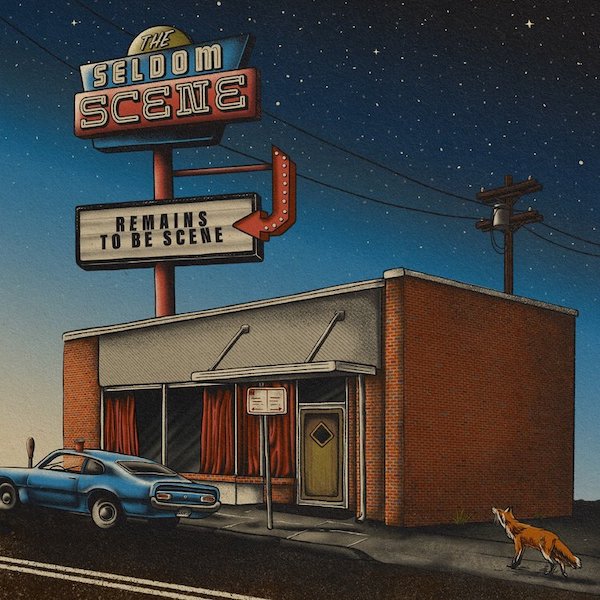
The Seldom Scene – Remains To Be Scene (Smithsonian Folkways)
Much more an institution than a band, the original Seldom Scene came together in 1971, as dobro player Mike Auldridge, bassist Tom Gray, mandolinist John Duffey, banjo player Ben Eldridge and guitarist John Starling descended upon the Washington, D.C. area and immediately started something new and noteworthy.
Most are well aware that bluegrass had become its own distinct musical form back in the ‘40s (thank you, Mr. Monroe) and developed, like country music, from the roots of old-time music, much of it getting its ‘high lonesome sound’ from the Appalachian mountain region.
In the 60’s, however, the more traditional bluegrass evolved through the addition of non-traditional instruments as acts like The Country Gentlemen (Gray, Auldridge, Duffey) moved further forward with more complex arrangements and elements of other genres of music.
In the early ‘70s, ‘newgrass’ took off – as bands like The Seldom Scene, The New Grass Revival and John Hartford pushed the envelope further afield, using electric instruments while blending in elements of folk, rock and jazz. However, for some, it was the crisp, clear vocal strengths of guitarist John Starling (more the folkie to John Duffy’s high tenor) who helped drew the attention of a much wider group of people, many of them younger than the regular bluegrass audience. Suddenly, bluegrass became more attractive and accessible to a younger generation who preferred the more relaxed approach of these ‘upstarts’ who – at their core – were fiercely loyal to holding high the gold standard of exceptional musicianship, coupled with a heartfelt desire to deliver a good time in the performance of it.
The Seldom Scene’s family tree has sprouted many branches over the past 50 years. Surprising it hasn’t toppled over with the natural changes of players. Phil Rosenthal replaced John Starling in ’77, while Rosenthal and Tom Gray left the band in ’86. Lou Reid and T. Michael Coleman joined the band, with Reid leaving in ’92. Starling returned briefly, replaced by Moondi Klein. When Klein, Coleman and Auldridge left to form Chesapeake in ’94, Duffey and Eldridge brought in Fred Travers, Ronnie Simpkins and Dudley Connell. When John Duffey passed in ’96, Reid returned to the band. Founding member, Ben Eldridge passed in ’24 and Dudley Connell – who performs in fine form on this release, retired in ’24. The current incarnation on this, their 24th release includes Lou Reid (guitarist/mandolin/vocals), Ronnie Simpkins (bass/vocals), Ron Stewart (banjo/fiddle/vocals), Fred Travers (dobro/vocals) and Clay Hess (flat-picking guitarist/vocals), who assumes the reins from Connell.
Despite all of these changes and transitions, The Seldom Scene has retained their delicious blend of old and new, of unrivalled playing skill – the sort that is kindled from the close personal chemistry between dedicated musicians. The Seldom Scene continues to possess a rare spirit which promotes both spontaneity and elasticity which, when mixed with their patented joie de vivre, is instantly audible, on-stage and on record.
When Ray Davies’ Kinks released the “Last of the Steam-Powered Trains” in ’68, it was one part of a sentimental, 15-track concept album lamenting a bygone era of good, ol’ England (Village Green Preservation Society) and more blues-based shuffle than anything remotely ‘bluegrass’. Yet, in the hands of The Seldom Scene, it is butter. While Reid’s vocal seems slightly strained at the higher end, the band chugs down the track at a perky pace, powered by an engaging bed of guitar, dobro, banjo and bass.
“Man at the Crossroads” features one of the band’s strongest lead vocals as Fred Travers, supported by full-band harmonies, is further elevated by beautiful touches of dobro and the lonely strains of Stewart’s fiddle.
You don’t see Jim Croce covered often enough and Dudley Connell’s animated, slightly huskier lead vocal on “A Good Time Man Like Me Ain’t Got No Business (Singin’ the Blues)” lends a honky-tonk feel as dobro, banjo, fiddle and guitar join Simpkins’ ever-present, pulsing bass to rivet their rollicking stamp to it.
Ron Stewart’s husky vocal joins Simpkins’ buoyant bass-playing to help transform Woody Guthrie’s “Hard Travelin’” study of the resilience of the working class into today’s reality, while Stewart’s banjo and the band’s jovial backup vocals energize its au current message.

Joan Baez made a Dylan studio outtake (from ‘65’s Bringing It All Back Home), “Farewell Angelina,” into a hit for her. It’s also one of the best tracks on the album. Credit Dudley Connell’s impassioned vocal, while generous flourishes of gentle guitar, weeping fiddle and the rich, resonant tone of Travers’ dobro round this out into a standout highlight.
Another Dylan cover is found in his ’62 “Walking Down the Line” recording for Broadside magazine. From its plucky banjo intro and Reid’s fervent lead vocal to the full involvement of the band, another feature track is realized. A rippling cascade of dobro, guitar, standout bass, mandolin and a great marriage of the full band’s voices is Seldom Scene firing on all pistons.
Travers returns on lead vocal with the comparably soft-spoken “Lonesome Day” – a delicate blend of their greatest powers as vocalists augmented by soft touches of fiddle, guitar, dobro and warm bass – all of which help offset the substantial sense of loss felt by the writer.
The upbeat “I Could Cry” is a bittersweet country tune boosted by its fiddle, banjo, guitar, dobro backdrop as Connell’s emotive lead adds a little twang to the piece.
The consummate treat on this release has to be their rendition of Willie P. Bennett’s “White Line,” released on his debut in ’77 and covered by The Seldom Scene on their highly recommended Live at the Cellar Door release (and also on John Starling’s solo debut). A sad song about life on the road, this soulful rendition follows along the same path, featuring a superlative vocal from Reid and some of Travers’ most remarkable dobro contributions, while acoustic guitar, compassionate fiddle, standout bass and the band’s full vocal accompaniment embellish this memorable masterpiece.
The band’s boisterous portrayal of “Show Me the Way to Go Home” showcases their exceptional ability as a vocal quintet, with Connell singing lead as Stewart’s banjo and Travers’ dobro take centre stage for a remarkable instrumental break.
A staple of the Johnson Mountain Boys, “The Story of My Life” receives an ample dollop of fun and instrumental mastery – the essence of The Seldom Scene. Connell’s hale and hardy lead vocal on the Wayne Walker original joins a rambunctious accompaniment by seasoned musicians who sound like they’re entirely infatuated with what they do.
The legend continues – much to our gain.
Find more details here on their website: https://www.seldomscene.com/
Musicians on the album are: vocals by Ben Eldridge – Doug McKelway, Dudley Connell (left end of 2024), Lou Reid – guitarist/mandolin; Ronnie Simpkins – bass; Ron Stewart – banjo/fiddle; Fred Travers – dobro; Clay Hess – guitar.
Produced by The Seldom Scene
Recorded by Jim Robeson and mixed by Jim Robeson and The Seldom Scene at The Bar in Rockville, MD. Mastered by Mike Monseur, Axis Audio, Nashville TN
Annotated by Ben Eldridge, Doug McKelway, Dudley Connell, Lou Reid, Ronnie Simpkins, Ron Stewart and Fred Travers
Executive Producers: Maureen Loughran and John Smith; Production Manager: Mary Monseur; Production Assistant: Kate Harrington; Editorial Assistance by Carla Borden
Art direction, design and layout by The Grass Spot, Richmond VA