


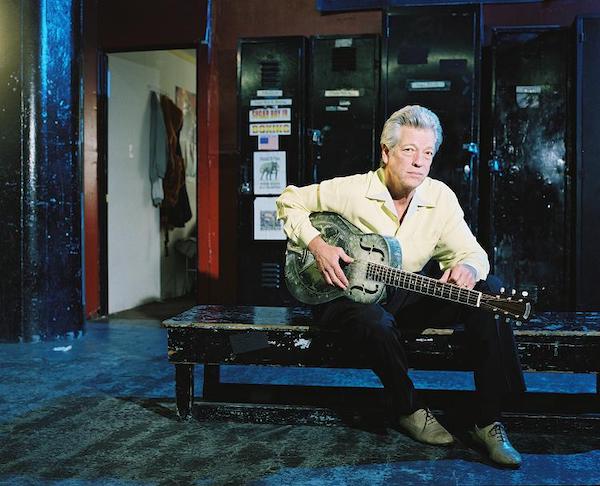
John Hammond photo by Jessica Chornesky
John Hammond is a renowned blues singer and guitar player with a new, extensive 3 CD set of his shows that were recorded at the Boarding House on June 2 & 3 1973 and recently released by The Owsley Stanley Foundation: You’re Doin’ Fine – Blues at The Boarding House San Francisco 1973. These sets were recorded by Owsley “Bear” Stanley, who was notable for recording the Grateful Dead extensively, along with other acts. They are part of the Owlsey Stanley Foundation’s “Bear’s Sonic Journals” serious, which is quite extensive and growing.
Over the two nights of this recording over 50 years ago, John performed dozens of songs by blues artists from well-known to relatively obscure. The recordings are John Hammond solo on his resonator guitar with harmonica. The result is gritty and captivating and showcases a lot of stamina and a wealth of musical knowledge carrying through those nights. The delivery is raw and the styles range through Delta, Chicago, Texas and Piedmont blues. You can enjoy our review of the 3 CD Set here: REVIEW: John Hammond – You’re Doin’ Fine – 3 CD Set
We had a chance to speak with John by phone briefly about the project and more.
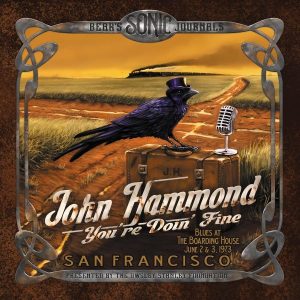

Americana Highways: The book that accompanies the CD box set is beautiful. The whole presentation of the music package is really surprisingly well done, and is a piece of art.
John Hammond: I am so awed by it myself. In all the years I’ve been recording, no record label has done this kind of packaging for me, it’s almost like a biography. The packaging was really impressive.
AH: It’s a work of art unto itself, and definitely fitting for you and Bear both.
The music speaks for itself, from the perspective of you and Bear. This was recorded at the Boarding House in San Francisco on June 2 and 3, 1973. And it’s just you, solo acoustic singing and playing harmonica over 45 songs. And it sounds fantastic.
JH: Yes. That’s a long time ago, so you might think it would lack some clarity. But the sound is unbelievable. Bear was the guy. At the time I had no idea of his talent and technical expertise, I was just happy that the sound was good. But now hearing it back all these years later, it’s just unbelievable.
AH: How did you get set up for the recording that night?
JH: I had no idea it was even being recorded at the time.

AH: Wow. How did you first get into the blues?
JH: When I first got into blues I didn’t care whether it was popular, I just loved the music for itself, and I got so into it that’s all I wanted to do in my live.
What happens to a talented person who gets into the pop syndrome and has to make the hit record over and over again. If it isn’t your life’s passion, it ultimately won’t work out. For me, I was just happy to be working at what I love to do and did what I had to do to make it happen.
I feel very fortunate to have come all this way all these years and have what I have at the age of 82 to have a thing be released like this is very satisfying.
I’ve always done what I wanted to do. I’ve had a lot of chances to record and travel all around the world.
AH: Who were some of your favorite artists to play with?
JH: I got to work with Howlin’ Wolf, Muddy Waters, and Buddy Guy, and just about all the rediscovered first generation artists like Son House and Mississippi John Hurt and Fred McDowell. I was on shows with all these guys in the early days. I got to see them play and feel their passion, it was truly inspirational.

I’ve also played with John Lee Hooker.

AH: I saw you worked more recently with Canadian artist Colin James?
JH: Yes. I’m not known as a songwriter but Colin James recorded a tune of mine and it just blew my mind, he’s such a talented guy. The song was “Come to Find Out.”
I was so honored. I’ve been on shows with him in the past and he’s a kindred spirit.
I’ve been playing gigs in Canada for 60 years and I’ve played in Colin’s hometown Regina, Saskatchewan. And his mother came to see me.
AH: Wow! That’s cool! You have also played with Levon Helm?
JH: Yes, I knew him really well. We were good friends. I met the Band in Toronto, and we worked gigs tougher, and I got them to back me up on a recording of mine, So Many Roads, in 1964, that was released on the Vanguard Label in ’65. I knew Levon really well.

AH: Did Jerry Garcia steal the song title from your album title? (laughs)
JH: (laughs) I don’t know, maybe? The song is by Otis Rush, that’s where I got my title from.
AH: I need to do some homework on Otis Rush.
JH: He has a song called “Homework” too. (laughs)
AH: The setlist on this Boarding House album is incredible.
JH: I am knocked out by it myself. I think the Stanley Foundation has done me and the songwriters a great service here.

AH: On the first set I see you played “Honeymoon Blues” twice. Why did that happen?
JH: (laughs) I broke a string on the song the first time so I decided to play it again.
AH: It sounded great both times! Hopefully this will put you right back in the spotlight. In my opinion the three most underrated blues artists are you, RL Burnside, and Junior Kimbrough.
JH: Thank you. I am so honored that the Foundation folks are so serious about including me in their philosophy.
AH: Are there any other shows that you played during that period that may have been recorded?
JH: I don’t know. I was on a show with the Dead in Colorado but it was on one of the nights that Bear was not there so I don’t think it got recorded. And I don’t know about any other gigs.
AH: These are solid sets from a blues perspective, and your vocals are so growly, and your playing is so lively, and, it’s very impressive that you were only 30 years old at the time.
JH: Thank you. Yes.

AH: You have “Wang Dang Doodle,” and “I Know It” from RL Burnside. It all sounds so great.
JH: The recordings are the epitome of clarity and of capturing the sound.
AH: Most people think of Bear as “the Wall of Sound” for the Grateful Dead, but he was so much more than that.
JH: I agree. I was so surprised to be presented with this, I hadn’t even realized it existed.
AH: How did you first hear about the Stanley Foundation project?
JH: They first approached me with the Doc Watson album. It’s phenomenal. The sound on that album was great and the performance was incredible.
AH: How well did you know Doc Watson?
JH: I knew Doc Watson from 1973. There was a bluegrass folk player named John Herald (of the Greenbrier Boys.) He was a musicologist as well as a great guitar player and singer and they recorded for Vanguard Records. John knew Doc Watson and brought me to the Old Time fiddlers’ convention around 1963 or ’64 and introduced me. Doc had heard my first record, and he brought me to his home in Deep Gap, North Carolina, and he asked me to play and recorded me on his Wollensak reel – to – reel tape recorder.
When I heard this recording that the Stanley foundation had made, I flipped out. And when then told me that they had one on me, that they had this show that I did way back when in 1973, I was amazed.
I din’t know what to expect and then when I heard it, it was like “Oh My.”
AH: It’s incredible. It’s just beautiful.
JH: I am overwhelmed. I feel proud to have my name on it.
AH: Everybody knows Muddy Waters, but albums like this put artists who weren’t as well known back into the spotlight a little bit. Your gigs then are bringing them to people’s attention again today.
JH: Yes. One more example is that I did “Hitchhiking Woman” by Black Ace.

AH: Great music is timeless, this is as relevant in 2024 as it was in 1973.
JH: I’ve always felt that a good song transcends time. The human condition doesn’t change fundamentally, and everybody can relate to the blues.
Thanks very much for speaking with us, John. You can find the music here: https://owsleystanleyfoundation.org/john-hammond-blues-at-the-boarding-house-june-2-3-1973/ and also find more details here on John’s website: http://www.johnhammond.com/