



Scott Gates and AJ Lee and the Summit photo by Natia Cinco
Scott Gates Of AJ Lee and Blue Summit On Building City of Glass
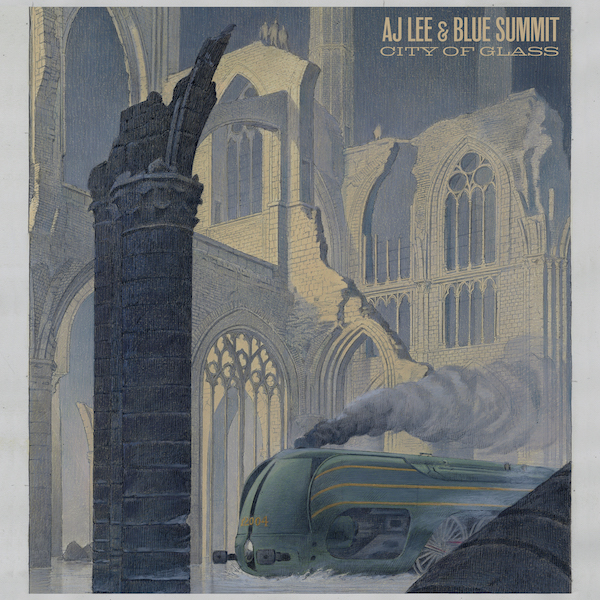
Contemporary Bluegrass band AJ Lee and Blue Summit are releasing their new album City of Glass on July 19th, 2024. Though it’s their third full-length album, it marks their first release through a label, Signature Sounds, and is a milestone for the relatively young band. They are currently out on tour and also out playing festival dates.
City of Glass reflects the diversity of the band members’ interests and inspirations, since they’ve always been multi-genre even while steeped in bluegrass and Americana music. For this album, AJ Lee, Sully Tuttle, Scott Gates, and Jan Purat worked with producer Lech Wierzynski of The California Honeydrops, recording mostly live and used older microphones to capture a particular ambience. Lee, Tuttle, and Gates have been playing together from a very young age, and Sully’s sister Molly Tuttle joins them on one of the album tracks. I spoke with Scott Gates, who plays guitar, sings, and has writing credits on the album, about writing methods, live shows, recording this time around, and about the stories behind some of the songs that he wrote for City of Glass.
Americana Highways: I see that songwriting on City of Glass was really shared among members of the band, so I think it’s a great indication of your personalities at work and also makes the album more varied.
Scott Gates: We all kind of agreed on that. That’s the name of the game for us. We all agree that variety is where it’s at. We come from a world of traditional bluegrass which we appreciate so much, and we understand the benefit of variety and keeping things fresh.
AH: When you, personally, are writing songs, do you follow what the song needs in terms of sound, or do you think about how it will fit into the band setting as a whole?
SG: Well, for instance, the song “Solicitor Man” was a song that I wrote simply for fun, as something for my friends to play. I don’t think anyone thinks, “What is the band going to think of this?” [Laughs] We all trust each other, and we trust each other’s taste. But that one, in particular, was written in the pursuit of writing something that would be fun for friends to play.
AH: I imagine you’d like it to be fun for you to play, too!
SG: Well, yeah! [Laughs] We play together because we have fun playing together. If we had a mission statement, that’s what it would be.
AH: How does that affect how you plan sets for shows, balancing lighter things and heavier things? Do you have a philosophy for how you design sets?
SG: Sometimes. I like to think of it kind of like telling a story. If one song’s about heartbreak, then the next one is about redemption, it tells some kind of a story. We also think in terms of setting, like if we know that we are going to play a rowdy festival, or a rowdy bar, we stack the setlist with honky tonk songs and fast bluegrass stuff, but you put waltzes in there and make sure there’s variety.
If we’re in a listening room, then we’ll try to play the stuff that has little tiny details that we want people to hear and we can mess around with dynamics a lot more. Another thing that informs the setlist is that AJ [Lee] had a pretty viral video with The Brothers Comatose doing “Harvest Moon,” so we tend to do that a lot in our encore. If we don’t do it, people ask for it, and it’s a good one, since it’s a sing-along.
AH: I noticed that there’s a big variety of venue types on this tour. I applaud you on being able to adapt from one night to the next.
SG: I love it, personally, because, again, it’s variety. You have to be able to roll with the punches, in the sense of sometimes being in a completely different spaces. The band, all of us, have not only been playing music individually since we were children, but we’ve been playing music together since we were young. All of us have done a million gigs. We’re going to bring it, regardless, and adapt to the environment.
Obviously, festivals are fun with thousands of people, and I’m starting to feel the most comfortable in that setting. But there’s something that’s so special about a small listening room. It can be extremely therapeutic, I think for everybody. I don’t care how “big” this band gets, whatever that means, but we all agree that we want to play specific smaller venues, even if that happens.

AH: One thing is that in those small environments, the hard work that you all have put into the writing and instrumentation comes out, and you can really hear the components of these songs. They are quite intricate. Do you all usually change things up when you play live, or do you try to stick to the original writing?
SG: There are some things that require sticking to the blueprint. There’s an old song that Sully does that was going around in the 1920s, called “Who Walks In When I Walk Out?” We took some time a couple of years ago, and rented this cabin up in the Rockies, and worked on songs and arrangements. We spent a few hours on a sixteen-bar section where we intricately figured out harmonies for each of us to play. We worked on those notes to say what we wanted.
Then there’s a song like “Glendale Train,” which is an old bluegrass song, where we put a section in the middle, where the train basically slows down. Then, there’s all these different grooves, which then speeds back up. That’s different every single time that we play it. It’s completely open to interpretation. When there’s a little jam section, we have cues that we give each other, when we’re improvising.
AH: How did you all approach recording the new songs for City of Glass?
SG: We wanted to preserve a certain ambience, so a lot of what we did was live tracking in the same room, with maybe some baffles set up. We even set up mirrors for each other, so we could see around the corner. We wanted to look at each other. Jan [Purat] wasn’t super-comfortable with just laying it down live, and wanted the ability to go back and re-record if he wanted to. So he sat in an isolation room on the other side of a sliding glass door. Mostly, it was a live thing, especially for harmonies. We sang harmonies together, and we used old mics. We tried to capture a crisp, slightly older, but clean sound.
AH: That’s wonderful. I think it’s great that you each got to set yourselves up in a way that made you comfortable, like Jan using a booth. Everyone got a vote. It’s very egalitarian.
SG: Oh, totally, this band is democratic, for sure.

AH: There’s a little funk and soul on this album, which your producer on this, Lech Wierzynski, is known for. Did working with him make you feel more free to blend genres in this way?
SG: I’m not sure about that, but Lech brought, “He Called Me Baby” to the table. He was the reason that we recorded that song. He has an encyclopedic knowledge of old recordings. We asked him to help with the record, and he took a hard look at AJ’s voice, and said, “You should do this song.” There are secret weapons in her voice that he realized, I think, hadn’t been used yet. It was a really good move. But if that song came to her any other way, we would have had the confidence to do it. I think Lech made it easier for us to do things like that.
AH: For the songs that you wrote on the album, you handle your own vocals. Did you feel like you were having to learn or figure out new approaches for your vocals?
SG: Yes, actually. I had it pretty much figured out for the two more Honky Tonk ones, “Solicitor Man” and “Toys.” But for “Bakersfield Clay,” there were still a few things that I wasn’t really sure about, how to express certain vowels and little runs that I wanted to do. I wondered if I should keep it simpler, or just do what was coming to mind. This is something that Lech helped with, actually. I ended up doing the vocals for “Bakersfield Clay” at his house, just me and him. I think I really needed the space to nerd out with him. He’s so much fun. He’s got that vocal coach mindset and toolkit.
In the studio, we did what we could, and I put down some usable tracks, but I wasn’t 100% on it. He gave me a lot to think about, like “The lyrics stand on their own. You don’t have to do anything to bring more attention to them. You can just sing that melody.” Since I wrote the lyrics, I didn’t have that kind of objectivity. He said, “You can just sing that melody. The words are powerful enough.” It worked out. And now I sing that song a lot more simply on certain parts because he proved it to me.
AH: That song is really interesting and has so many call-backs to traditional elements. It’s such a mood, and such an atmosphere that you’re creating. I can see how the vocals have to stay almost unhurried, or untroubled, even though the story is very emotional. Your lyrics are also very spare.
SG: That just comes from listening to a hell of a lot of old country and cowboy music, which I listened to a lot growing up. And then there’s bluegrass. I was just at the point where I was realizing that if you just read bluegrass lyrics on a page, it’s some of the most heartbreaking stuff! It’s really sad and poetic stuff. But if you hear it played, it’s so up.
AH: From what I can see, you like writing from character perspectives. That’s something that’s big in country, folk, and bluegrass, but I think it’s getting less common to speak in a character’s voice. Why do you like that? It’s very theatrical.
SG: Well, how much of it is a character, and how much of it is meeting putting on a mask, so I can express myself? Part of it is that, for sure. I do really like the idea of speaking through characters instead of just telling stories where this happens, and then that happens. Instead you can say, “I got on the train, I went to town.” You take on that character. That’s something you see a lot in Irish music, and Irish stuff is so important to bluegrass. It’s like half the game.
AH: It makes sense that a character can be a portion of your own personality, that you kind of split off and that one part gets to tell their story. That can be really illuminating. It’s something that people can relate to.
SG: Totally. In “Solicitor Man,” it’s kind of tongue-in-cheek, but it’s about how it feels to busk for a living, which I did for years in Santa Cruz, and also Santa Monica, and up and down the coast. It is a character. I’m not someone who’s going to take your money and run, but I definitely lived the life that it’s talking about. It’s biographical, too, in that way.
AH: It’s being that somewhat seen and somewhat invisible person, that busking musician. It shapes a lot of musicians hugely.
Thanks very much for chatting with us, Scott Gates. You can find more details and information on the band website here: https://www.bluesummitmusic.com/
Enjoy our previous coverage here: Interview: AJ Lee and Blue Summit — “I’ll Come Back”