

Patterson Hood and John Moreland at the Ram’s Head in Annapolis
Patterson Hood and John Moreland write very different kinds of songs. Hood looks outward, telling stories about the world around him, while Moreland looks inward, tracing the quiet fault lines of his own life. Sunday’s double-bill at Ram’s Head On Stage in Annapolis demonstrated what they share: a poet’s instinct for the right word, and songs that belong unmistakably to their own voices. The stage was almost bare. Two guitars leaned against their stands, a single microphone between them, and a music stand off to the side. Nothing more. The setting made clear what the evening would rely on: songs, voices, and the quiet attention of the audience.

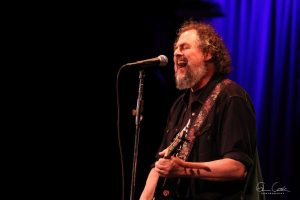
Patterson Hood opened the show playing acoustic versions of songs drawn from across his career with Drive-By Truckers and from his recent solo work. Stripped of the band’s usual roar, the songs took on a different shape, their storytelling sitting squarely at the center. Four of the fourteen songs Hood played came from his 2025 solo album Exploding Trees and Airplane Screams. Others reached further back into the Drive-By Truckers catalog, including “My Sweet Annette” and “Scott’s Sister,” both songs that feel almost like Southern short stories drawn from Hood’s Alabama upbringing. That sense of narrative runs through much of Hood’s writing. His characters often wrestle with the weight of their choices and the passage of time. The tension surfaces in songs like “Lookout Mountain,” with its haunting line about wondering who will end up with his records, and in the recurring sense that someone, somewhere, will eventually have to answer for those mistakes.
The humor in Hood’s songs can be just as sharp. Introducing “Uncle Disney,” he joked that it was his first attempt at writing a children’s song — though the refrain about “when they thaw out Uncle Disney” makes clear that Hood’s imagination rarely travels in gentle directions. Late in the set, 2004’s “Putting People on the Moon” brought the room to a boil. Strumming his battered Harmony Supertone H610 “Melody Ranch” Gene Autry Round-Up with passion, the song’s working-class frustration still resonates. The anger Hood has said he felt about the country’s political divisions sounds even more timely today:
They can put a man on the moon And I’m stuck in Muscle Shoals just barely scraping by.
By the time Hood closed with “The Living Bubba,” one thing was clear: playing solo and acoustic does not necessarily mean a gentle performance. He sang:
I keep living just to bend that note in two And I can’t die now ’cause I got another show.
The emotional temperature shifted immediately when John Moreland took the stage. Hood had played a vintage Harmony guitar whose rough edge matched his gravelly storytelling; Moreland’s Martin HD-28 delivered a warmer, fuller tone that carried the quiet gravity and profound sadness of his songs. There are sad songs. And then there are John Moreland songs.
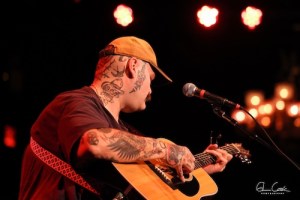
Moreland delivered songs built from spare arrangements and melodies that unfold slowly but decisively. On the surface they share the same sound, yet each charts its own emotional landscape. He opened with “Hang Me in the Tulsa County Sky.” The song’s opening line — “My heart is heavy from the everlasting hurt” — set the mood for his set: melodic, beautifully sung, and almost unbearably sad. Moreland’s arrangements are simple but carefully shaped. While many solo performers lean heavily on harmonica when playing acoustic guitar, Moreland used it sparingly. In “Latchkey Kid,” for example, the harmonica felt less like accompaniment than a second voice entering the conversation. Many of Moreland’s songs grapple with the uneasy feeling of not quite belonging anywhere. In “Blacklist,” he searches for “the place where I fit,” while later in the set “Visitor” returns to the same idea with the quietly devastating line, “Everywhere I go, I am a visitor.”
Unlike Hood, Moreland offered almost no explanation for his songs. “I don’t know what any of these songs are about,” he told the audience with a shrug. “If I did, I’d tell you. Everything I know is in the songs.” And that’s how they are presented — without framing or explanation, leaving listeners to find their own way inside them. The set closed with one of his best-known songs, “You Don’t Care for Me Enough to Cry,” a fitting, and memorable, final note. For all their differences, Hood and Moreland have this in common: their songs feel inseparable from the people who wrote them. Hood’s storytelling leans on the conversational cadence with which he delivers it, while Moreland’s plainspoken lines draw their power from the weary gravity of his voice. Hood’s songs map the world around him; Moreland’s explore the landscape within. Different directions, to be sure, but both rooted in the deeply personal songwriting at the heart of great Americana. And both men, on this night, still bending the note, still telling the story. https://www.johnmoreland.net/
https://pattersonhood.com/ Enjoy some of our previous coverage here: Interview: Key to the Highway: Patterson Hood and here: Show Review: John Moreland Brings Sad Songs and Quiet Salvation to the Ram’s Head Mark Pelavin, a failed retiree, is a writer, consultant and music in St. Michaels, MD. His free newsletter, A Feather in the Wind, is at https://markpelavin.substack.com/.