


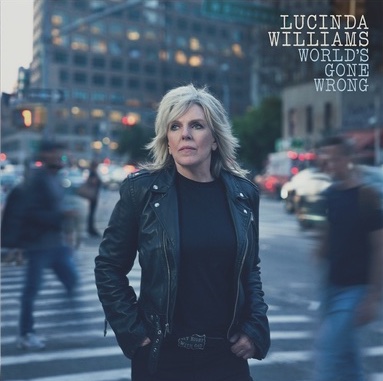
Lucinda Williams World’s Gone Wrong
Lucinda Williams is pissed off.
And now she’s given us World’s Gone Wrong, the protest album I have been waiting for, a set of songs that speak plainly and forcefully to the dark moment we are living through without hedging or nostalgia.
Political songs are notoriously hard to pull off. Too often they slide into sermonizing, or substitute slogans for insight. Powerful lyrics are frequently undercut by cautious, bloodless music. Here, Williams avoids every one of those traps. These songs don’t merely argue — they move. They rock. They roll. Guitars snarl and grind, refusing restraint.
I didn’t expect an album this forceful to arrive as the sixteenth release by a 72-year-old stroke survivor who now has difficulty walking onstage — though her voice, unmistakably, remains fully intact.
There is a tradition in American folk music of imagining that songs might be enough — that music could heal what politics breaks, or restore what power corrodes. Williams has never shared that illusion. What she offers instead is something tougher and more honest: witness sharpened into accusation. The songs on World’s Gone Wrong do not promise salvation. They insist on clarity. And call for action.
World’s Gone Wrong opens with its thesis statement in plain language and working-class detail. The title track sketches a couple doing their best to get by — selling cars, working shifts, worrying about rent, trying to sort truth from lies — and finds its refrain not in outrage but endurance: “Come on baby, we gotta be strong.” It’s a song about collapse seen from the kitchen table, not the podium. Comfort comes not from denial, but from connection — turning off the news, putting on some Miles, dancing barefoot across the floor.
From there, Williams sharpens her edge. “Something’s Gotta Give” builds its case through repetition and pressure, its metaphors blunt and elemental: too much rain, too much strain, too much pain. The song gathers force like a storm that’s been a long time coming. “How Much Did You Get for Your Soul?” goes further, framing corruption not as abstraction but as transaction — a deal willingly taken, with consequences that can’t be explained away.
Crucially, the album refuses to remain in a single emotional register. “Low Life” offers temporary escape — jukebox blues, cheap drinks, Slim Harpo on repeat — not as denial, but as survival. Protest music that never breathes eventually collapses under its own weight; Williams understands the necessity of pleasure, even refuge, amid the wreckage.
That sense of endurance is reinforced by the album’s collaborators, whose voices extend the argument rather than dilute it. When Mavis Staples joins Williams on Bob Marley’s “So Much Trouble in the World,” it feels less like a feature than a conversation across generations — two women shaped by different eras, united by the same unresolved struggle. Staples brings the gravity of gospel and the civil rights movement into direct dialogue with Williams’ hard-earned clarity, grounding the song’s warnings in lived history rather than abstraction. On “We’ve Come Too Far to Turn Around,” Norah Jones adds a quieter resolve, her voice reinforcing the song’s weary determination without softening its message. And Brittney Spencer threads contemporary urgency through the harmonies, linking Williams’ voice to a younger generation navigating its own version of the same storms. What unites these performances is not style or era, but perspective: women bearing witness, refusing erasure, and insisting that survival itself can be an act of resistance.
The album’s moral center may be “Black Tears,” which links the present moment to a much longer American history — deferred dreams, burning churches, blood in the river. The song refuses resolution, returning again and again to images of grief and endurance, asking what has been learned, and what still hasn’t been.
Williams has pushed into explicitly political territory before, most notably on Good Souls Better Angels, but World’s Gone Wrong is the first time she has made the moment we’re living in the album’s central concern.
Recent Americana protest albums have often approached politics at an angle, filtering outrage through autobiography or historical framing. Margo Price’s Strays confronts power, gender, and freedom through personal liberation; Jason Isbell’s Reunions wrestles with civic responsibility through self-examination; Tyler Childers’ Long Violent History frames protest as historical reckoning. Those records matter, and they’ve expanded what political songwriting in Americana can sound like. World’s Gone Wrong does not keep its distance. Williams speaks directly, without allegory or remove, trusting plain language and hard-earned authority. This is protest music without illusions — furious, clear-eyed, and built to last.
World’s Gone Wrong was produced by Ray Kennedy and Tom Overby, both longtime collaborators of Williams. Overby, Williams’ husband and closest creative partner in recent years, has co-written and co-produced much of her late-career work, while Kennedy has helped shape the raw, guitar-forward sound of several recent albums. Backed by a core band featuring Brady Blade on drums, David Sutton on bass, and the interlocking guitars of Doug Pettibone and Marc Ford, the record favors urgency over polish — a production approach that suits its anger and intent.
Taken as a whole, World’s Gone Wrong isn’t just timely — it’s formidable. It stands among the strongest albums of Williams’ career, and one of the most uncompromising protest records of recent years.
What drives World’s Gone Wrong isn’t outrage alone, but exhaustion — the kind that comes from knowing better and seeing the same harm repeated anyway. Williams’ anger doesn’t seek release; it seeks reckoning. These songs don’t ask for hope. They demand attention. And in that demand, they find their staying power.
Find more information here on her website: https://www.lucindawilliams.com