


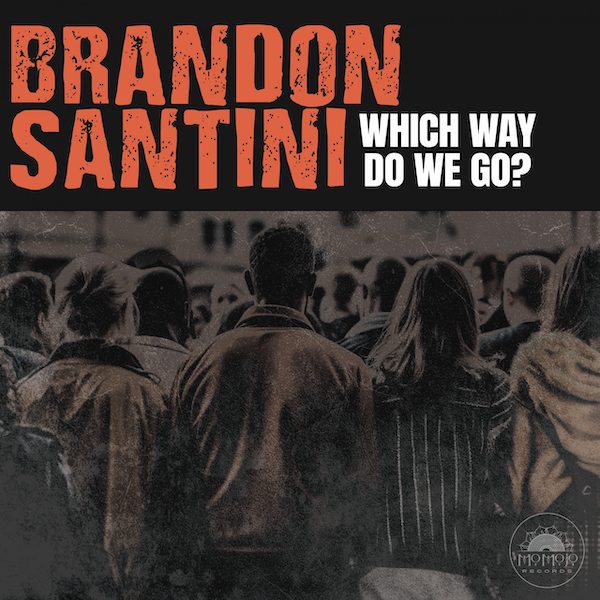
Brandon Santini Which Way Do We Go? (MoMojo Records)
If you’re a blues fan, we tend to lament the early days of traditional blues – and the loss of the giants who birthed them. With the passing of each and every musical hero from our past, we grow even more sensitized to all that we’ve lost. If you love blues harmonica: Little Walter, James Cotton, Junior Wells, Paul Butterfield, John Mayall – all head-turning harmonica players and singers, they’ve become larger than life over time. Yet we’ve not lost more than we’ve gained. An ever-evolving sea of modern blues acts like Curtis Salgado, Dennis Gruenling, Billy Branch and the ever-extraordinary Charlie Musselwhite (naming but a few) keep the torch lit in this essential, ever-progressive and highly-energized category.
A lesser-known artist like Brandon Santini may seem like a new kid on the block, but this ferocious, North Carolinian-born, Memphis-weaned blues singer and harpist has been carving out something new for more than two decades. Teeth cut in a Memphis-based band, Delta Highway, was a 4-year crash course in the business before releasing his first solo effort, Songs of Love, Money and Misery. Five more solo releases followed, which not only put him on the radar, but earned him multiple nominations for the Blues Music Award.
Over time, Santini has advanced his sound into a blues hybrid with a contemporary twist. Originally a blues traditionalist, he’s less than comfortable with descriptor ‘blues-rock’, favoring the less precise category of ‘contemporary blues’. Surprisingly, he was spurred into playing at 15 by an act which brought as many new blues fans to the table as it alienated those who considered them more rock than blues: Blues Traveler. Even as John Popper’s rebellious approach to the harmonica yielded fresh sounds – stretching boundaries in the process – and Blues Traveler helped breathe life into the jam band league, the raw power and ferocity of Popper’s performances inspired a young teenage boy into asking his mother for a Hohner harmonic – Popper’s weapon of choice.
The result is a player who is well-steeped in the blues of the past, the rock of his youth and a sense of social responsibility – lyrically, at least – to try and right the wrongs of a world gone crazy. Which Way Do We Go? is the consequence of Santini’s current state.
Remember the impact of Alan Wilson’s (‘Blind Owl”) harp and vocal approach to Canned Heat’s “On The Road Again”? Rock was never the same. Santini has a similar mission – although equipped with an entirely different set of skills.

The title track is quite impressive. Slow, if not plodding, peppered with harp, Santini’s low, attention-getting, gruff voice (think a gentler version of Omar Kent Dykes – Omar & the Howlers – sung through a wool sock) locks the listener into position as he questions the current state of society. Band-mates, Timo Arthur (guitar), Ron James (drums) and Cliff Moore (bass) round out this road warrior’s chosen team – each of whom perform professionally and efficiently, keeping Santini and his harp in the front row. Somewhat surprisingly, the band applies hand-claps, as in some sort of a revival. At first off-putting, it grows on you.
Likewise, “The War Ain’t Over” – another anthemic track which portrays the uncomfortable reality we find ourselves living in. His processed, mechanical-sounding voice adds to the dark and muddy mix, which includes an aggressive drum beat, a darker guitar edge and an actual ‘chorus’, while Santini’s meaty harmonica is featured throughout. The handclaps are back – acting more as an agent of percussion while a guest vocalist (Jesse James Davis) adds a slight gospel edge to the plea.
The straight-ahead “See That Pony” merges Jensen’s vocal to Jeff Jenson’s guitar, with a simple, pulsing drum beat and Santini’s hearty harp, delivering the substance of the song.
“Ain’t Turning Back” is one of the album’s key tracks – with its slow-speed, Bayou-dipped groove. James’ tom-tom pounds out a beat to Arthur’s moody guitar accompaniment. Santini is on fire here – his vocal oozing with personality and character, his harp used more sparingly but to greater effect. Although the lyrics paint a story of love, if not lust, the band seems to position it against a somewhat menacing backdrop – where moss hangs from the trees as an ominous fog rolls in. Tennessee Screamer, Jesse James Davis adds even more depth to the composition with charismatic background vocals.
There’s something peculiarly Doors-y about the guitar line on “Do What Comes Naturally” (“Back Door Man”?) yet the song marks another stand-out direction on this release. High-pitched harmonica joins the tough guitar line and convincing vocal, while Arthur finally steps into the spotlight to add scorching lead and wah-wah guitar to this shadowy portrait of right and wrong.
Another stand-out track is a co-write with producer Jeff Jensen, doubling on guitar for “Mile After Mile”. Slow and pokey, its laidback groove – again – tastes of Bayou while Santini’s more relaxed vocal suits him to a tee. Jensen’s guitar cuts a swath with a rhythm section locked in tight. Cue some buttery harp as the band adds color to each tired and lonely step down that endless, dusty road. Seriously, stand-out.
“Working on a Mystery” is a co-write with guitarist, Timo Arthur, and Jensen stepping back in on guitar. It’s more of a rock’n’roll attack, showing Santini’s vocal range, as his harp fills in any gaps in this hearty boogie. The band keeps pace and Davis’ backup vocal adds something special to Santini’s rambunctious blitz of a style.
If “Trouble Stay Away” reminds you of a Canned Heat throwback, it’s the bass of Cliff Moore and the guitar of Timo Arthur which drives this song, as Santini’s vocal and tasteful harp accompaniment transforms this relatively simple tune into something worth singing about. Not much to it but it hits a nerve.
Not surprisingly, “Blues So Bad” reveals the band’s ability to perform straight-up blues – where Santini’s low-down vocal and sweet-but-muscular harp seals the deal. It’s a well-rounded, beefy band workout which injects more creativity into the overall arrangement to land a great composition.
Moore’s bass is the hero, here, on “Baby’s Got Soul”, which gives him room to demonstrate the nimbleness of his instrument, building a deep groove, as James’ simpatico beat lays a solid foundation. At almost 5 minutes, the song has time to develop, with great guitar work tightly engaged with Santini’s red-hot, room-filling harp. Again, it’s a simplistic approach but it’s one of their most dynamic songs which almost seems to end too soon.
The last track is very upbeat – almost a dance track, extending the band’s parameters. Arthur rips into some blistering guitar, while also providing his unique tone on rhythm, while Santini reminds you that his harmonica plays a fundamental role in this band. “She Got the Way” provides an ideal choice to close out the set.
Despite enduring spinal surgery and the hard knocks of life on the road, this trooper is in it for the long haul and clearly has the skills to make a distinctive mark. Recording with the same squad which hits the tour bus can only further hone a sound which is already making some waves. Armed with Santini’s forceful presence – both in the intense power of his voice and the wall-crushing strength of his harp-work, their potential is palpable. The fact that, given that these are all Santini originals (2 co-writes), also reminds you that they’ve also got something meaningful to say.
Find more details here: https://www.brandonsantini.com
The album was recorded at High/Low Recording in Memphis. It was produced by Jeff Jensen; mixed by Pete Matthews and Toby Vest; engineered by Toby Vest, Pete Matthews, and Ron James; and mastered by Brad Blackwood at Euphonic Masters.
Musicians on the album are Brandon Santini on lead vocals, harmonicas, electric rhythm Guitar (track #2), and hand claps; Timo Arthur on electric guitar (except track #6), acoustic guitar (track #9), and hand claps; Jeff Jensen on electric guitar (tracks #1, 6, 7), acoustic guitar (track #7), backing vocals (track #1), and hand claps; Cliff Moore on bass and hand claps; Ron James on drums, percussion, and hand claps; and Jesse James Davis on backing vocals (tracks #1, 2, 4, 7).